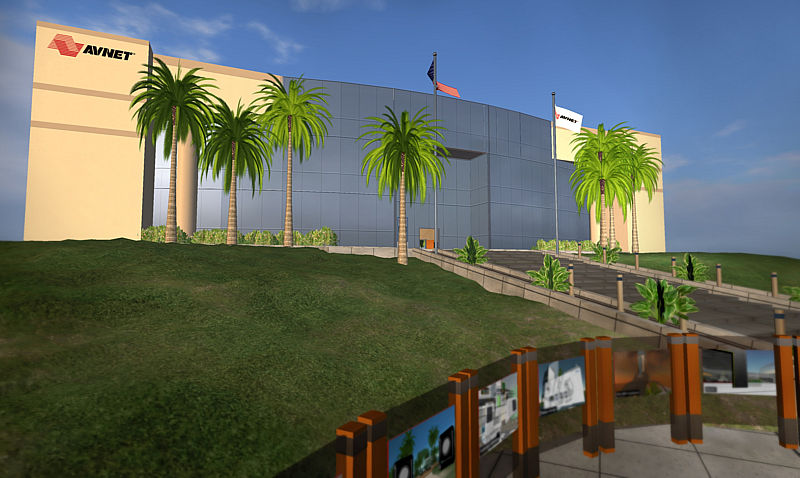
In 2005, Avnet built a technology museum in the lobby of its corporate headquarters in Phoenix, Arizona to celebrate fifty years of incorporation. I was one of the designers and its curator. The museum was a great experience for visitors and employees, but if you wanted to see it, you had to come to Phoenix.
I wanted to fix that. We spent two years trying. I worked with an outside firm to build a virtual version. They couldn’t deliver. I explored QuickTime VR and a number of other options for getting a 3D museum experience onto the web. The tools were clunky, the user experience was bad, and nothing gave you the feeling of actually being in the space.
Then I was at a spring training game and it hit me. Second Life.
My wife and I were already deep in the Second Life community. I was Zee Pixel. She was Zora Spoonhammer, a builder and developer whose work in Second Life was already drawing coverage from tech press and attention from federal agencies. She was generating real income from in-world item sales. Not hobby money. She paid for a Scion xB out of her Second Life earnings. That was just a slice of the portfolio from the development studio she was running at the time.
Second Life in 2006–2007 was exploding. Businesses were opening virtual storefronts. Universities were building campuses. Reuters had a bureau there. And I realized it was the perfect platform to build a three-dimensional representation of the Avnet museum that people could actually walk through.
The Build
I helped design the physical museum and several of the displays. Now I was going to build it again.
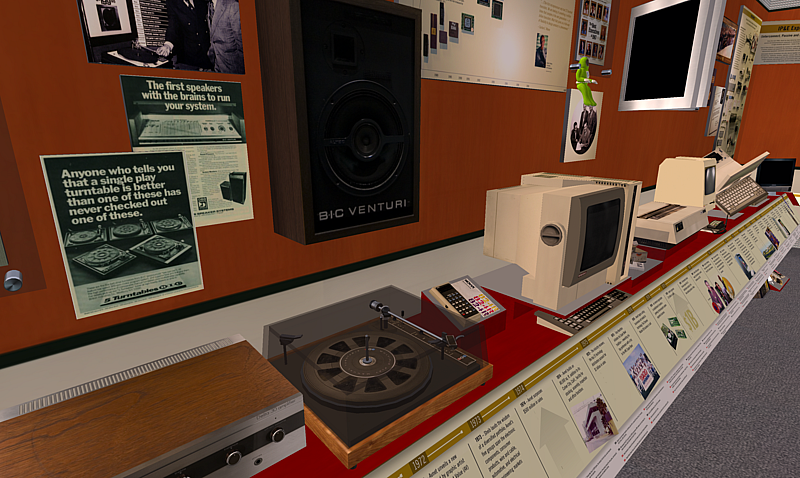
I rented a full sim. That’s the Second Life equivalent of leasing commercial real estate. Then, before we touched a single prim, I spent several days with the team photographer doing light box photography of every single museum asset from every conceivable angle. While the assets were being shot, we used a DSLR to detail photograph every aspect of the lobby, the adjacent meeting rooms, and the outer façade. More than 2,000 reference images. We built the reference library first. Then we built the museum.
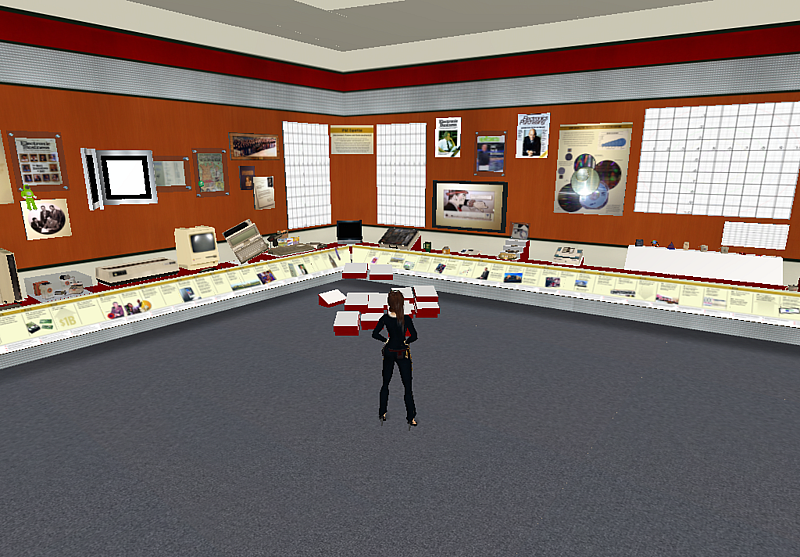
This was a full construction project. Just digital. I contracted the build through TFPSoft, executed by Zora Spoonhammer. I handled composition, design, and all of the backend infrastructure and integrations. She executed the build. What we delivered wasn’t a gimmick. It was a faithful reconstruction of the physical museum space with a full technical stack running underneath it.
The museum had two video walls streaming content from the Avnet.TV video platform I was building for the company. It had an RSS feed pulling from the Avnet.com news aggregator. A live stock ticker. Clickable business line cards linking to real PDF downloads from our divisions. A digital receptionist with a dialog tree that could forward visitor feedback to a corporate email inbox. A visitor survey that emailed results. A tracking beacon that reported every visitor to me in real-time. Over its three-and-a-half-year run, that beacon logged more than 2,100 visits with timestamps.
I built a partner portal using Second Life landmarks, connecting the Avnet space to the Second Life presences of our channel partners. The same companies we worked with in the real world had virtual presences, and I mapped that ecosystem inside the build.
And the build itself contained something I’m still proud of. A closet. Inside the closet were boxes. Each box was labeled as a build component, and inside each box were all of the subcomponents for that section of the build. The entire museum was stored in boxes in a closet. If you wanted to reconstruct the museum from scratch, you could walk into the closet, take copies of the boxes out, unpack them, and every asset would be there. The build contained its own blueprint. The architecture documented itself.
Visitors consistently said the same thing: they felt like they had actually been in the real space.
The Reach
The museum won the MAC Judges’ Choice Award for Most Innovative Project. It was one of the earlier corporate museum builds in Second Life, and it got cited frequently at the time for its construction and design quality.
University professors used it as a classroom. I gave tours to classes each semester, walking students through the novel ways we were representing data in three-dimensional space. The closet was always the thing that got them thinking. How do you store a building inside itself? How do you make architecture that includes its own reconstruction manual?
Inside Avnet, business units saw the build and immediately started asking what else it could do. Channel partner development wanted to run customer meetings in the space. HR and talent development explored using it for recruiting and onboarding. Major tech publications covered the project. An InfoWorld columnist got a private tour and wrote it up as a centerpiece example of enterprise virtual world strategy, putting Avnet alongside Coca-Cola, Wells Fargo, P&G, and Toyota. Trade press reached out after seeing the project at enterprise SL events. I’ve got those interviews and coverage archived.
The museum ran from August 2007 through February 2011. When I wrote the internal FAQ introducing the project to Avnet leadership, the first line of the document was: “Bringing Avnet to the Metaverse.” That was August 2007. Fourteen years before the word became a pitch deck.
I also made sure to document the whole project, because if you don’t keep track of your efforts, nobody will do it for you.
Beyond the Museum
Because Zora was also my spouse, I was careful about how the relationship was represented internally. But this was not a case of handing opportunity to an unqualified vendor. She was already one of the strongest builders in the ecosystem, with a substantial portfolio, press attention, and paid commercial work behind her. Zora’s Second Life work went well beyond the Avnet project, and her reputation in the arts and sciences community gave the museum additional visibility. She had also built Sculpty Earth: a complete topographical recreation of the globe built from government elevation data. The clever part was the surface layer. She overlaid it with a real-time cloud coverage visualization pulled from polar satellite weather data, showing the last 24 hours of global cloud movement from actual satellite imagery.
You could go into Second Life, find this object, and watch 24 hours of real global weather patterns rolling across accurate terrain. Clouds interacting with mountain ranges. Storm systems tracking across oceans. All from real data in a real, tangible 3-D visualization that made the cloud/terrain interactions visceral. That same effort was applied to the museum.
Sculpty Earth appeared in a collage of visuals that Philip Rosedale presented during his congressional testimony on Second Life. NOAA was running a multi-sim Science on a Prim exhibit, and Zora gifted them a copy to deploy in their own environment. A federal agency used her work as part of their public science education program.
Why This Matters Now
I spent the last six years as CTO of a construction technology company. The through-line is not a coincidence. Building things in virtual space. Building things in physical space. The problems are the same: how do you represent complex systems, how do you make them navigable, how do you document them so someone else can reconstruct what you built.
I used the word “metaverse” in a corporate strategy document in 2007. Not because I was predicting the future. Because that’s what we were building in. Not as a concept. Not as a pitch deck. As a working corporate tool that won an innovation award, taught university students how to think about data in three dimensions, and logged over 2,100 visitors across three and a half years of operation.
The tools change. The instinct doesn’t.