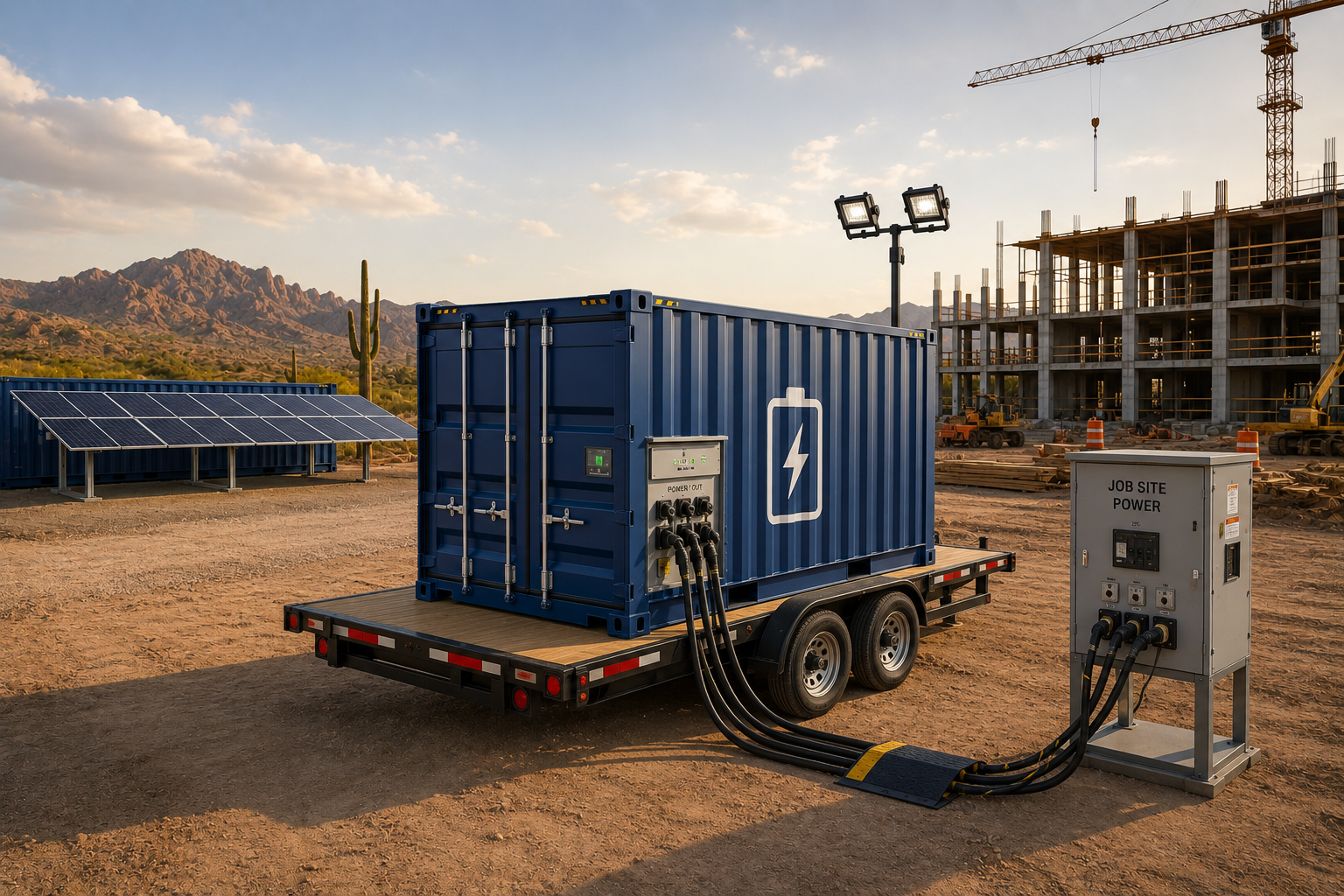
A Zero-Fuel Construction Power System I Designed in 2021, and What the Market Proved Five Years Later.
Construction runs on diesel. Generators on every site. Fuel trucks making rounds. Nobody questions the cost because it has always been that way.
In the fall of 2021, as Construction Technology Manager at a Phoenix-based general contractor, I questioned it.
The company was running multiple active jobsites. Every one of them had generator costs, fuel logistics, and temporary utility hookups adding drag to the budget. I wanted to know whether the entire fuel dependency could be removed from the jobsite power equation. Not reduced. Removed.
Finding the Starting Point
I started where any real technology investigation starts. Not with a product search. With a phone call to someone who had been working the problem longer than I had.
I reached out to Nathan Johnson at Arizona State University, who had published work on portable hybrid power systems. Nathan pointed me to BoxPower, a California company manufacturing containerized solar microgrids, and gave me a piece of context that shaped everything that followed. He told me that a lot of groups had tried to get into the portable hybrid power business over the previous decade but many had backed out due to cost structures and logistics challenges. The space, he said, was far heavier with ideas than commercial offerings.
That assessment from an academic researcher in October 2021 proved prescient to market events later in my story.
I called BoxPower the next day.
Designing Around Real Constraints
After talking with Alex Cavoli at BoxPower I had a solid starting point on equipment. Their MiniBox model is a 4-by-8-foot palletized enclosure with integrated solar, battery, and inverter. Self-contained. Towable. But their standard deployment assumed you could install solar panels at the point of use.
I knew from running our jobsites that this would not work. Construction sites have footprint issues that frequently prevent on-site solar panel installation. Equipment staging, material laydown, active work zones, overhead obstructions. The sites could not accommodate panels. This is the kind of thing you know from standing on the dirt, not from reading a spec sheet.
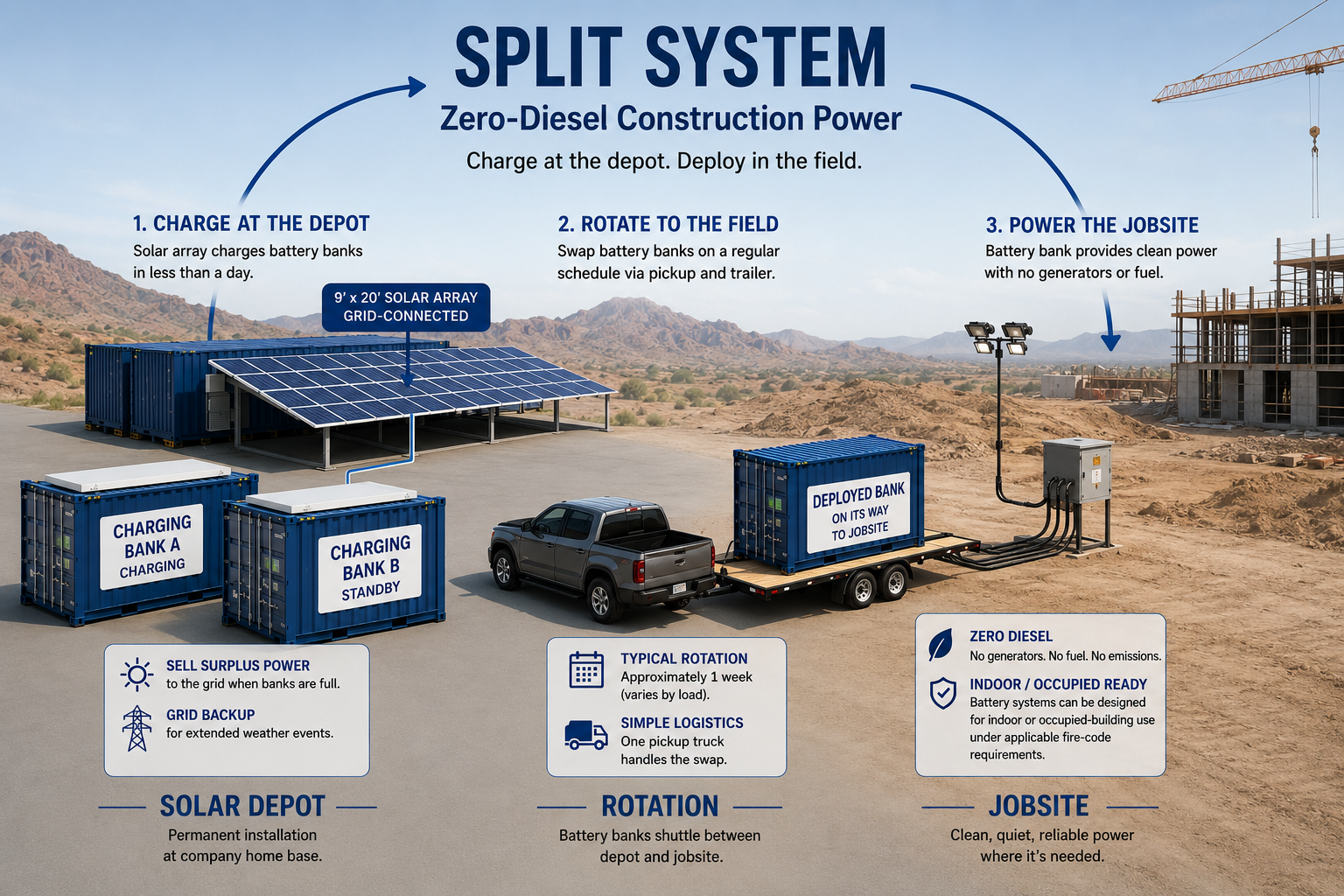
So I designed a split system. Separate the charging from the deployment.
A solar array goes at the company’s home base as a permanent installation. Containerized battery banks shuttle between the depot and the field. One bank is on site powering the project. The other is at base, charging off the array. When the field unit runs down you swap them via a trailer pulled by company pickup. The site never needs panels, never sees a generator, never takes a fuel delivery.
The solar footprint at the depot is 9 by 20 feet. In Arizona a full charge takes less than a day. The system is grid-connected so it can sell surplus power when the banks are full and pull from the grid as backup during extended weather events. Thermal management for the battery banks in Phoenix summer heat was factored into the depot design based on field deployment discussions with BoxPower. That parasitic cooling load is part of the operating cost model. BoxPower now ships a trailer-deployable version of their unit, which further simplifies the rotation logistics.
Building the Cost Model
I built the cost model against real data from one of our hotel construction projects. Not estimates. Actual invoices.
On the investment side: two BoxPower MiniBox units at approximately $50,000 each. Shipping, installation guidance, and setup in the $20,000 to $40,000 range. Total deployment cost in the ballpark of $150,000, plus land for the permanent solar depot.
On the savings side: the project was spending $800 to $1,000 a month on generator rental and $1,000 to $2,000 on fuel. Call it $2,000 a month on the low end. Grid-connected temporary power through APS ran $300 to $700 a month before you counted temporary pole rental, installation, and removal costs that never showed up in the utility number.
I also asked BoxPower about expected lifespan for both the battery banks and the solar panels. Deployment cost tells you what the system costs to buy. Lifespan tells you what it costs per year of useful life. That is the number that matters for a capital expenditure decision. You are not modeling a purchase. You are modeling an asset.
The rotation period for two containers at peak consumption was approximately one week, possibly longer during lower-use phases. One pickup truck handles the swap. You scale by adding containers as you bring more sites into the system. Every additional site that rotates through the depot amortizes the fixed investment faster.
On cost elimination alone the model showed a recovery window of four to five years on a single project. With grid surplus revenue from selling excess solar production back to the utility, the window compressed to approximately three years (again, against 2021/22 rates).
What I Got Right
The core thesis was sound. The market proved the demand was real. Moxion proved the danger of scaling the technology without solving the operating model. Here’s where Nathan’s concern proved out.
Moxion Power, the highest-profile startup in mobile battery storage for construction, raised $100 million in a Series B round in 2022 and delivered hundreds of units into major construction and industrial markets. Portable Electric now has over 850 units deployed across 14 countries. The containerized solar generator market was valued at 463 million in 2022 and is projected to nearly double by 2032.
The forcing functions I anticipated are now arriving as regulatory, reporting, and procurement requirements. Unlike combustion generators, battery systems can be designed and deployed for indoor or occupied-building use under applicable fire-code requirements. Emissions reporting requirements are tightening. Client sustainability mandates are becoming standard in RFPs.
Moxion scaled like a venture-backed tech company and filed for bankruptcy in August 2024. Nathan Johnson had called the failure mode three years earlier. The space was heavier with ideas than commercial offerings. The cost structures and logistics challenges that had stopped previous attempts stopped Moxion too, even with $100 million and contracts with the biggest GCs in the country.
The technology works. The demand is real. But the business is not software; it is equipment utilization, field logistics, charging infrastructure, maintenance, permitting, and dispatch discipline. The market I identified from a $150,000 construction-company deployment is the same market that later attracted venture capital at scale. Moxion proved the opportunity was real, and its failure proved the operating model matters as much as the battery. The only reason my employer at the time didn’t move forward with the proposed deployment is they pivoted out of GC operations into specialized framing production that shifted site deployment from years to months. The expenditure didn’t work out anymore.
In conversations with utility contacts at SRP in June 2026, I learned that at least one industrial operation in Arizona is already running prototype deployments of battery rotations on remote work sites. The same swap model I designed for construction in 2021. Mining, aggregate, and construction share the same fundamental power profile: heavy intermittent loads, temporary or remote deployment, no permanent infrastructure. The concept has moved from theoretical to pilot stage in adjacent industries operating in the same state.
What I Would Update
A credible analysis requires revisiting assumptions when conditions change. Here is what has shifted since 2021.
The grid surplus revenue stream has deteriorated in Arizona. APS ended traditional net metering and replaced it with “net billing” at residential export rates of approximately six cents per kilowatt-hour in 2026, roughly half the retail rate of thirteen cents. SRP residential rates are even lower at under three cents. Rates vary by customer class and a commercial depot installation may be treated differently. The ACC authorized a ten percent annual decrease in the APS export rate every September through 2032. The grid revenue I modeled is a fraction of what it was in 2021 and shrinking every year.
This is geography-dependent. States like New Jersey, Massachusetts, Colorado, and Virginia still offer full or near-full retail net metering. In those markets the surplus revenue is real and compresses the payback timeline as originally modeled. A deployment strategy in 2026 needs to account for local regulatory environment in a way that was less critical in 2021.
On the other side of the ledger, APS has filed for a fourteen to sixteen percent rate increase currently in evidentiary hearings as of mid-2026. The power being displaced on site costs more every year. Diesel is up. Generator rental rates are up. Utility temporary power is up. Battery costs are down. The savings side of the equation has grown even as the revenue side has shrunk in certain markets.
New revenue mechanisms have also appeared. Virtual power plant programs and demand response participation did not exist at scale in 2021. In 2026 they offer 400 to 600 in annual revenue per enrolled battery system. For a fleet of charging depot batteries, this is a partial replacement for the lost net metering income. In conversations with renewable energy attorneys working in Arizona policy, I have been told that “virtual power plants” is the regulatory category the ACC is applying to distributed commercial energy assets like this. That framing matters because it determines the permitting and interconnection path. The battery swap model itself likely does not require ACC clearance beyond what is needed for the solar deployment at the charging depot. That is a lower regulatory bar than I had assumed.
The broader pattern is also accelerating. In April 2026, NVIDIA partnered with smart panel manufacturer SPAN and homebuilder PulteGroup to deploy XFRA compute nodes on residential homes. These are liquid-cooled server units containing 16 NVIDIA GPUs that use unused electrical capacity in neighborhoods to run distributed AI inference workloads. Homeowners get subsidized electricity and home battery backups. SPAN claims it can deploy 8,000 units six times faster and at one-fifth the cost of building a comparable centralized data center. The first 100 nodes are going into new construction in a southwestern state, likely Nevada or Arizona, in Q3 2026. Most of the people working in Arizona energy policy that I have spoken with were not yet aware of this project.
The XFRA deployment runs on the same underlying logic as my construction battery system. Distributed energy assets at the grid edge, managed through smart infrastructure, generating value from capacity that would otherwise sit idle. The difference is the payload. Mine powers a jobsite. Theirs powers AI inference. The regulatory questions are identical. How does the ACC classify commercial hardware running on residential or non-traditional electrical service? What interconnection framework applies? The fact that these questions do not have established answers yet means the window for early deployment, before policy hardens, is open now.
I have not remodeled the construction battery numbers with 2026 inputs yet. But the direction is clear. The recovery window has compressed on the strength of cost elimination without needing grid revenue at all. And the regulatory environment, while still forming, appears more permissive than I had originally expected.
What This Demonstrates
This project ultimately did not get funded as the company’s business model changed direction before deployment. But the work I’ve laid out represents how I approach technology problems as a construction technology leader.
Start with a real operational cost that everyone else treats as fixed. Find the people who have been working the problem. Evaluate their solutions against actual field constraints. Design around the constraints your sites actually have, not the ones in the vendor’s brochure. Build a cost model against real invoices. Ask the lifespan question so you are modeling an asset, not a purchase. Identify where your revenue assumptions depend on external policy. Track those assumptions against market reality over time and be honest when they break. Stay in the room where energy policy is being discussed so you know when the regulatory landscape shifts before it shows up in a trade publication.
The bones of this system exist. The engineering is not exotic. The economics work on cost elimination alone. The market validated the concept and then taught a $100 million lesson about what happens when you try to scale it without understanding the operational environment.
The gap in construction technology has never been the technology. It is the integration. It is knowing that your sites cannot accommodate solar panels before you design a system that requires them. It is knowing that a company pickup and a weekly rotation schedule is a logistics solution that already exists in your fleet. It is knowing what you are actually spending on generators because you have looked at the invoices.